
One of more common cryptic species you see while snorkelling and diving are scorpionfish. To the untrained eye they are almost impossible to spot. These are ambush predators. They lie in wait for unsuspecting prey to swim overhead before gulping them whole. This means they have to be exquisitely camouflaged and precisely match their background. But how do they do this? It’s a question that’s been bothering me for some time. The colours they become, can’t even be seen at depth. Water absorbs the light in those parts of the spectrum and since they can only be using vision to detect their background, how is it even possible? How scorpionfish sense invisible light for camouflage in the deep remains a mystery.

Every fish is a different colour
Scorpionfish are popular with snorkelers and divers. Their glorious patterning is more intricate than the most sophisticated Persian rug. They have big eyes, a slightly disappointed gaze and are covered in ornamental tassles. You’ll never see a scorpionfish that looks the same.


But scorpionfishes don’t only manage to match the colour of the coral almost perfectly, they also match the balance and diversity of colour too: pinks, reds, oranges, blues and greens. Like squids and cuttlefish, their skin contains specialised cells called chromatophores. These contract and expand to produce various colours and when researchers first looked at this in 2023, they even had to alter their method, because the change happened surprisingly fast.
How does the fish know what to look like when it can’t see the colours around it?
As depth increases colour disappears starting with the reds, which are the longest (lowest energyEnergy and nutrients are the same thing. Plants capture energy from the Sun and store it in chemicals, via the process of photosynthesis. The excess greenery and waste that plants create, contain chemicals that animals can eat, in order to build their own bodies and reproduce. When a chemical is used this way, we call it a nutrient. As we More) wavelengths. Then the colours disappear in the order they appear in the rainbow. The yellows and greens go next. The sea appears blue because that’s the final primary colour that gets reflected. Well, we say that, but in reality, the sea glows with ultraviolet light.
This graph shows how this works. At 7.5m almost all the red light disappears. Yellow is gone by about 15m but Ultraviolet light and blue light persists much deeper. Hence why the sea is blue.

Corals at depth, for example, appear black to us. Only when we photograph them using a flash, do they appear red.
Here is an image I took of a Pygmy Seahorse in Raja Ampat earlier this year. The left image is what the camera saw under light. The right image I’ve manipulated to look more like it did when we were observing with the naked eye. The bright red fan coral appeared a deep blue colour.
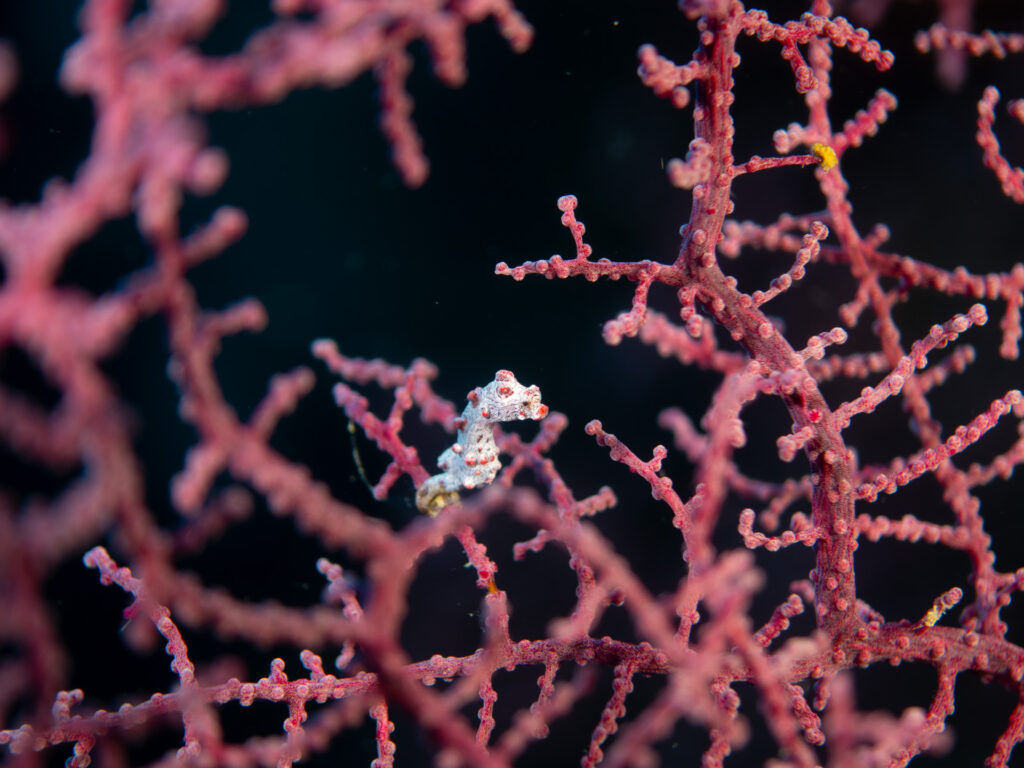
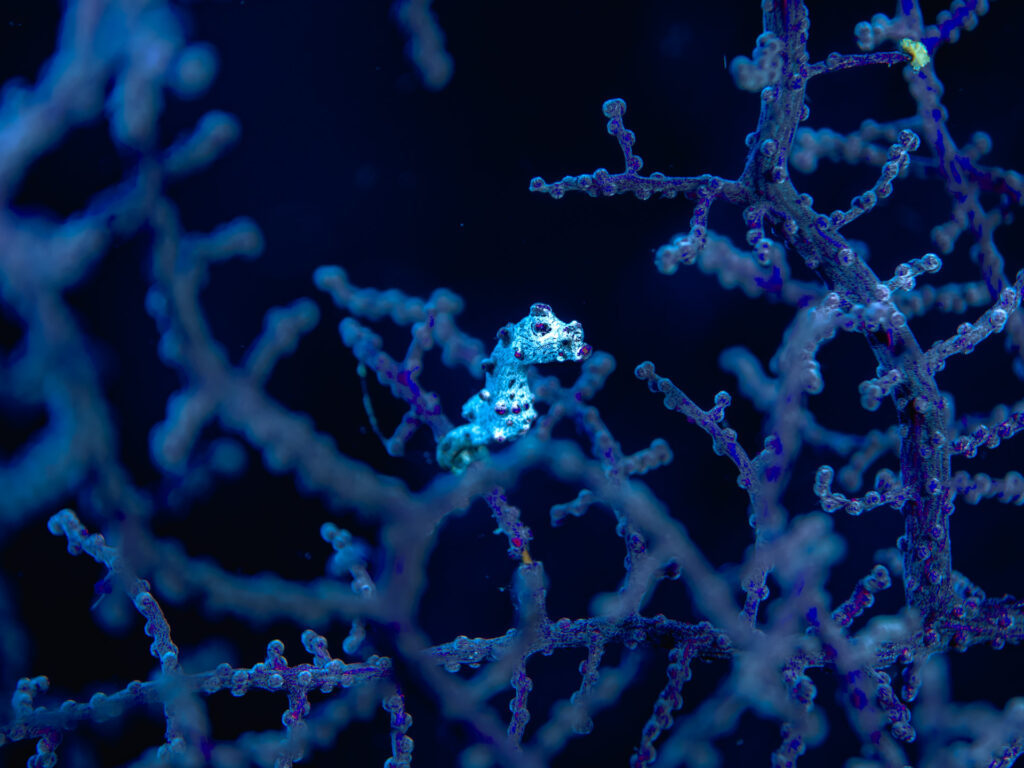
This is because the red end of the spectrum disappears close to the surface, leaving only blue light to reflect off the coral.
The scorpionfish’s ability to camouflage is more impressive when you realise they must doing this based on vision alone. When the reds, pinks and oranges of natural light aren’t visible to us, how do they even know to change into those colours? They must have far more sophisticated eyesight to adapt to their background. They see things we cannot sense ourselves.
The role of fluorescence
Many marine substrates are fluorescent. Even though sunlight is minimal, as the graph above shows, UV light penetrates deeply. It’s enough for animals to absorb its radiation all day and then emit it at night. If you’ve watched the film Avatar, the fluorescing animals under the sea are a metaphor for this phenomenon.

It’s thought that marine substrates produce a lot of fluorescence. Scorpionfish also produce red fluorescence at depth as was shown in this study in 2014.

The fluorescence we’re talking about can’t be seen by the human eye. Our vision isn’t good enough. But we can replicate this using artificial light. If we shine UV (blue) light onto the reef top, we can supercharge its reflective cells and see creatures such as fimbriated moray eels, lizardfish, anemones and corals glowing. Marine creatures at depth must have vision that can clearly see even the slightest of this daytime afterglow.
Here are some images from a snorkel in Wakatobi that we did to see this for ourselves.


Red fluorescence, even though it’s subtle, seems to contribute strongly to background matching in scorpionfish at night. In other words, the fish can not only see this fluorescence (invisible to us) but produce it as well – a handy trait when you’re a nocturnal ambush predator. This type of covert camouflage may be important among reef fish but is still rarely researched.
Does the mystery remain unsolved?
Fluorescence doesn’t necessarily explain how accurately the fish can emulate their background in nature during the day. Unless of course, there is some correlation between the colour of fluorescence and the daytime colour of the substrate. Chromatophore cells might also have a ‘resting colour’ that is red. And that when they are triggered, they can alter colour throughout the spectrum based on different depths. Yet scorpionfish can appear almost white when they are on pale soft corals, even at depth.
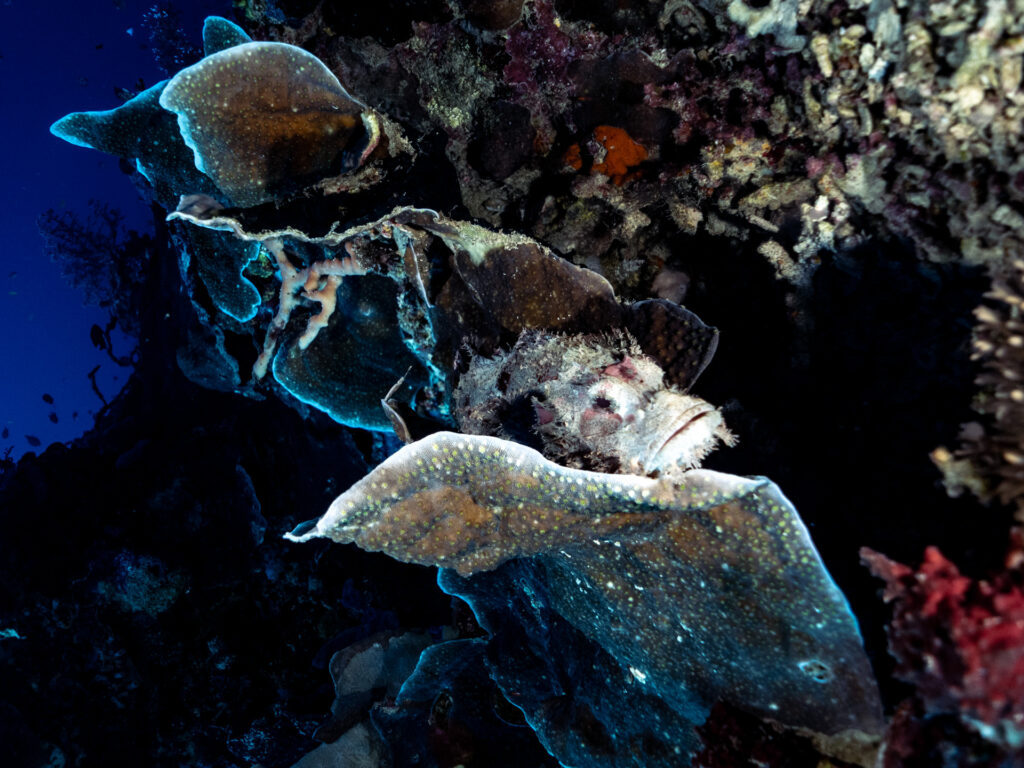
It’s also possible that the fish have eyesight that is good enough to detect the very faintest trace of those yellows, reds and greens left that we can’t see. Or, that they deliberately choose places to rest, where they’ve evolved to ‘understand’ the colours. These are the kinds of sophisticated sensory opportunities that surpass our understanding of how the world works.
We are literally only beginning to scratch the surface of our learning about nature. What I find constantly remarkable is how these mysteries exist in plain sight wherever we go. There is an ever-present diversity of wonders to marvel at in our world.