
Introduction
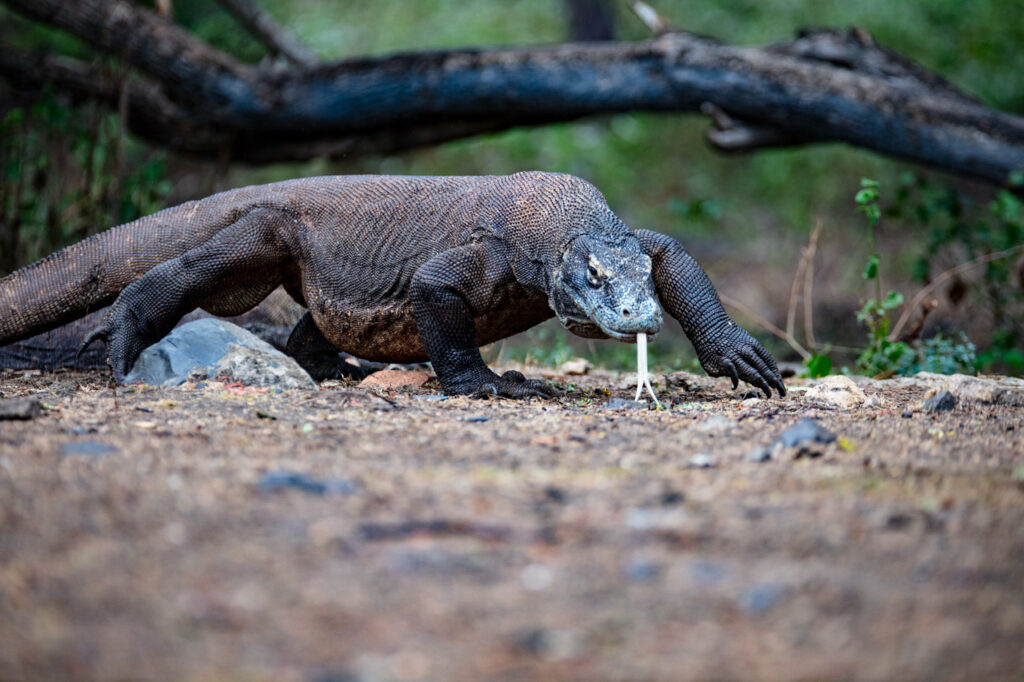
How did the Komodo Dragon survive so long? Just 400 square kilometres of habitat remains for a remnant of population of this giant animal that once roamed over 5 million square kilometres. The evidence for this comes from fossils found in Australia dating back 300,000 years. This isn’t the most interesting fact though. This is a story about language, culture and the survival of Komodo Dragon. How extinction was avoided, against all odds, due to human folklore and belief. The connection between the people of Komodo Island, the Ata Modo, and this prehistoric animal reveals something important about our relationship with nature.
This is a reptile equivalent to the Woolly Mammoth. But unlike the mammoth, the dragons survived the arrival of humans in their world. Which is more than can be said for the Ata Modo. ConservationWhy is animal conservation important? Animal conservation is important, because animals are the only mechanism to create biodiversity, which is the mechanism that creates a habitable planet for humans. Without animals, the energy from today’s plants (algae, trees, flowers etc) will eventually reach the atmosphere and ocean, much of it as carbon. The quantity of this plant-based waste is so More has jeopardised their way of life altogether. By throwing their culture into peril, we may also jeopardise the future of Komodo Dragons.
I’m in Komodo right now to learn about this important region. The next trip with Pindito will be in June 2027. You can find out more by visiting https://wildiaries-travel.com/.
When giants still ruled the Earth
Recent research puts pay to assumptions about how Komodo Dragons came to be so large. On the Galapágos, giant turtles evolved due to a process dubbed ‘giantism’ where animals can become larger when isolated. It has been suggested this is how Komodo Dragons may have evolved. Now we know this is not the case at all. They were large long before.
Komodo Dragon bones have been found almost as far south as Brisbane, Australia. The earliest fossils found on the island of Flores date back almost a million years. A few hundred thousand years ago (the early Pleistocene epoch), the dragons walked as far as Java. In all that time, the species has remained almost unchanged in form.

This was a time when the world was ruled by giants and there were no people. The Australasian continent was a lot bigger and wetter too. The dragons were part of an incredible array of other megafauna such as Diprotodon, a type of giant wombat, giant sloths and marsupial lions.
Arrival of the first humans from Sahul
About 65,000 years ago when sea levels were lower than today, a land bridge formed between Australia and Papua New Guinea. This long-lost super-continent was named Sahul.
This is when the first human hunters arrived in Australia, the ancestors of today’s Traditional Owners. They eventually altered much of the continent’s climate by introducing burning practices. The megafaunaThe largest animals that represent the top of the trophic pyramid. These are the final building blocks in ecosystem structures for maximum entropy production. Megafauna can be measured at any spatial scale. The largest animal that ever lived on Earth is the Blue Whale. In a grassland, spiders could be considered megafauna The term is generally reserved for animals larger More started to die out and were finally hunted to extinction. But these first settlers had no cultural connection to nature. Initially there was no belief system about how to survive in synchrony with the Australian land.
Today, hunting animals remains a key component in the culture of Indigenous Australians. Although after 65,000 years, that connection to country has developed strongly. Nevertheless, in the early few thousand years of their arrival, it would have been a difficult time for people and animals alike. A whole continent became shaped into a new ecological state. This is when the Komodo Dragon disappeared from much of its home range.
Meanwhile, in the west of remote Flores, something different was happening. The people of that island adopted a way of living alongside dragons that became key to the mutual survival of both species.
The original custodians of Komodo
The Ata Modo are the ethnic group of people indigenous to the island of Komodo. They even have their own endemic language. The island they called Tana Modo.


MosheA Creative Commons Attribution-Share Alike 4.0 International license
However, the creation of a national park in the 1980s led to their enforced removal from the land and a halt to all their indigenous practices. Since then, the local population has risen with tourism operators and other outsiders attracted to the natural wealth from neighbouring areas. The Ata Modo culture has gradually been displaced and diluted. Much of their language and many of their customs have been lost.
Their cultural identity, deeply intertwined with their connection to the land, suffered profound blows. Ceremonies and rituals tied to specific locations became impossible, severing their spiritual link to their ancestral home. Their knowledge of the island’s ecology, accumulated over generations, was deemed irrelevant, and replaced by top-down management strategies often insensitive to the Ata Modo’s lived experiences
– Andre Barahamin, Disposessed in Paradise
While burning and land clearing on mainland Flores killed almost all remaining Komodo Dragons, the Ata Modo had long practised their subsistence living to the dragons’ benefit. It’s sometimes suggested the dragons prosper by being generalists but that wouldn’t explain their catastrophic range contraction in the last few hundred thousand years. In actual fact, the dragons survival for the last 65,000 years – only on these tiny island sanctuaries – was only made possible by the Ata Modo customs.

This human cultural dimension to wildlife conservation is too often overlooked by conservationists. The relationship between the Ata Modo and Komodo Dragons is one of the greatest examples of human-animal interdependence we have. If that relationship fails, we may fail to protect the dragons. But we can also learn from this as it unlocks ways of doing conservation differently.
Speaking the language of dragons
Our guide, an Ata Moda man called Fatir, lives in a village on the island of Rinca. The dragons, he tells me, are always present when they play football. Baby dragons live on the roof of the school.

People and animals have always communicated in ways we cannot necessarily comprehend fully in scientific terms. But it stands to reason. All animals understand threat and opportunity. Words repeated by the Ata Modo would elicit a reaction among older, wiser dragons who may have previously been hit with a stick.
Seeing the reaction of the larger lizards, younger animals scurry away too, recognising the threat and associating it with the new sound. In this way, the culture of dragons is passed down over generations. Their culture becomes an extension of our human language and behaviour … and visa versa.

Living side-by-side, animals each learn cues about when to stand our ground and when to back away for our own safety. It’s a two-way communication. Some of this is in how we each sound. It’s also in body language. Much of it is based in fear and respect, which are two sides of the same coin.
Fatir and his colleagues remark how Komodo dragons still understand their language. Sebai peso! means ‘dragon, stop!’ A man called Mansa was bitten and the dragon kept returning to bite again. An Ata Modo man shouted to the dragon and it retreated back into the bush.
The legend of the dragon siblings of the Ata Modo.
The Ata Modo refer to the dragons as sebai, which means ‘sibling’. This remind us that they they were bound to the dragons by the spirit of the land and their own ancestors’ history.
The origin story for Komodo Dragons involves a Princess, Putri Naga, who gave birth to a son, Gerong, and a daughter, Orah. Orah became a mighty Komodo dragon. Together, the people and dragons ruled the island, maintaining a balance between nature and humanity.


It is said that when hunters came to kill the dragons and threatened the island’s serenity, the people and dragons rose up together. The mighty Orah frightened the hunters away.
It’s significant that elder Ashita adds ‘if there is no hunting then the brother does not know that his twin sister is Komodo.’ In other words, unless there is continuation of traditional hunting on Komodo, how can the people truly believe in, and care for the dragon’s connection to themselves and the land?
Among western conservationists, the idea of hunting and conservation in a national park may be irreconcilable. But who are we to say? Against all odds, this way of life had secured the dragon’s survival for tens of thousands of years. It also kept local people healthy, rather then dependent on imported junk food, like today. To throw away all this wisdom would seem cynical.
The future of Komodo conservation: theory or practice?
You can’t protect nature by isolating animals from people; and people from the land. Because people and animals need each other to survive. Culture is an integral part of how we see ourselves in nature and, therefore, why we might protect it. If that culture doesn’t survive (or exist) then animals don’t survive, and neither do we.
Who knows when or how exactly the origin story of Komodo Dragons came to be. But one thing is for certain, that moment spawned the Ata Modo’s deep personal regard and custodianship of the dragons.

The past, present and maybe future of wildlife (and therefore, our own species) depends on this more than anything else. ‘Why’ we protect nature is more important than ‘how’. The latter can only be determined by science but the former is found only in the minds of those wise enough to ‘know’ and believe in something greater.
‘… tourism is an easy option; in the long term we need to nurture and regrow traditional belief systems and support the remaining few custodians of natural wisdom as they look after the animals on our planet as part of their coexistence with nature. Working with communities is the best way to do this.
– The Surprising Elephant Economy, in ‘How to Survive the Next 100 Years: Lessons from Nature.

When science and culture collide
The science we do to try to ‘manage’ wildlife means little or nothing, unless there is a true belief in the species’ protection by the people who live there. The Ata Modo do not like seeing dragons caught and studied. For them, it would be best to allow the dragons to be dragons. They have, after all, been protecting them that way for millennia.
Scientific yearning shifts the value and commoditises the animals but does nothing to instil the firm and immutable belief in the dragon’s right to exist.
It’s not enough that anyone values an animal. Tourism can be important, especially if it’s at the request of local people. It helps them be what they need to be, to conserve the places they live and love. But it’s temporary. Value is not transformative. Values change. They can be bought, sold or become too expensive to maintain.
The Ata Modo people believe in protecting dragons, irrespective of whatever value anyone puts on them.
Beliefs tell us why wildlife conservation is important
Belief is permanent. Most conservation and development works in theory but cannot be scaled or sustained until local people are given sufficiently to believe in the need to act and preserve nature.
Humans are innately capable of empathy. But when we reduce the complexity of conservation down to scientific principles alone, we become blind to shared wisdom. To the things that science cannot explain. Science is a practice of words, maths and logic. Despite having the ability to speak this to each other, we will still fail to understand the true meaning of someone else’s connection to nature. Words are powerful but open to misinterpretation. Humans do not equally understand words like ‘hunting’ unless the words are lived by and felt. What the Ata Modo mean by sebai (‘sibling’) has no meaning to outside cultures either.
Yet what the animals meant to the Ata Modo became the sole reason for the Komodo Dragons’ survival for tens of thousands of years.
Only a cynic could imagine that millennia of cultural development might be replaced in a few decades. Especially by conservationists who have very recent connection to the land. Or that objective and purposeful connection could be rebuilt from words by people for whom they have no meaning in the context of the land or its wildlife.
These learnings can otherwise take thousands of years to recreate.
The extinction of the Ata Modo’s language and culture will, for these reasons, be putting the future of the Komodo Dragon in jeopardy.
The lesson from nature
The lesson from nature is that when we exclude people from conservation and disrupt the cultural connection we have with our own wildlife, all our survival is affected. On the plus side, there is still time to restore this and I’m confident it will happen in due course. One thing is for certain, the world is eagerly looking for these types of solutions and conversation like this are becoming more common by the day.