
It’s time to return to the roots of my blog and why I wrote Wildlife in the Balance in the first place. The argument I continually put forward is our need for the right balance of wildlife in ecosystemsHow ecosystems function An ecosystem is a community of lifeforms that interact in such an optimal way that how ecosystems function best, is when all components (including humans and other animals) can persist and live alongside each other for the longest time possible. Ecosystems are fuelled by the energy created by plants (primary producers) that convert the Sun's heat energy More. Animals are, literally, humanity’s only hope. Why do we still not understand this fully? Another example has been cropping up recently. The oak processionary moth is described, like so many creatures, as a ‘pest’. Northern Europe’s warmer weather is leading to an eruption of their hairy caterpillars in parks and gardens throughout the continent. The problem being that the caterpillars’ hairs are toxic to pets and people. In this article, I ask are Great Tits the solution to Europe’s hairy caterpillar plague?
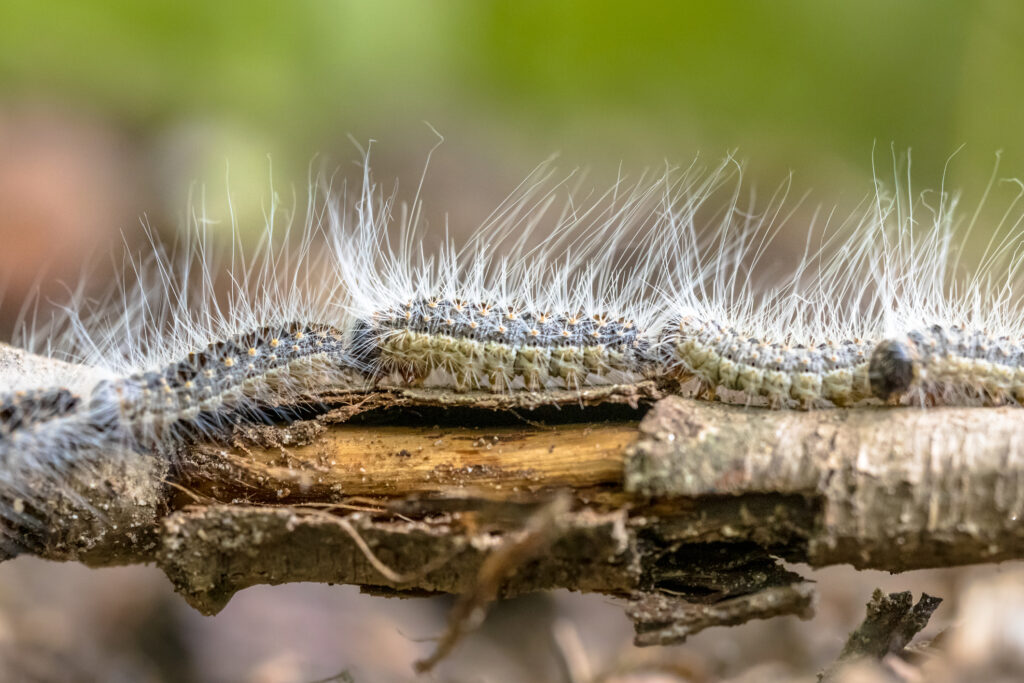
We are still trying absurd solutions to nature-based problems
In Berlin, parks have had to be closed to the public. There are even teams of people in Hazmat suits in cherry pickers using vacuums to suck up the nests from trees. This brings to mind a paragraph I wrote in Wildlife in the Balance about catastrophic locust plagues in Kansas in 1874, that led to ‘JA King from Boulder [inventing] a locust vacuum cleaner and farmers using a sheet of horse-drawn iron covered in tar like a giant piece of fly-paper.’
Obviously this isn’t going to work. Imagine the cost to taxpayers if this had to be done at scale.
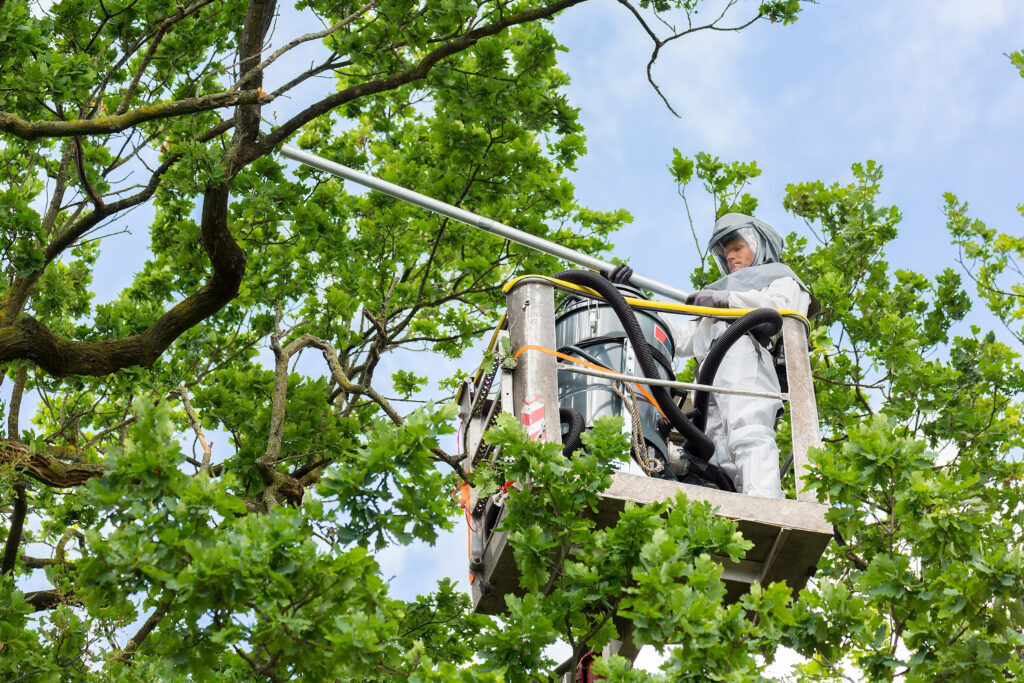
Not much has changed after 150 years. Humans are still believing it’s best to control nature using absurd man-made technology. If that doesn’t work we use poisons, which not only kill the caterpillars but harm the bird life that would keep things under control.
Are Great Tits the natural solution?
The humble Great Tit occasionally features in my writing as they are a remarkable bird. Recently I heard and saw them at breakfast on the island of Flores in central Indonesia. Their range covers most of Europe and Asia and they were a common garden bird when I grew up in England. They and their kind might just provide the solution for northern Europe’s moth plague.
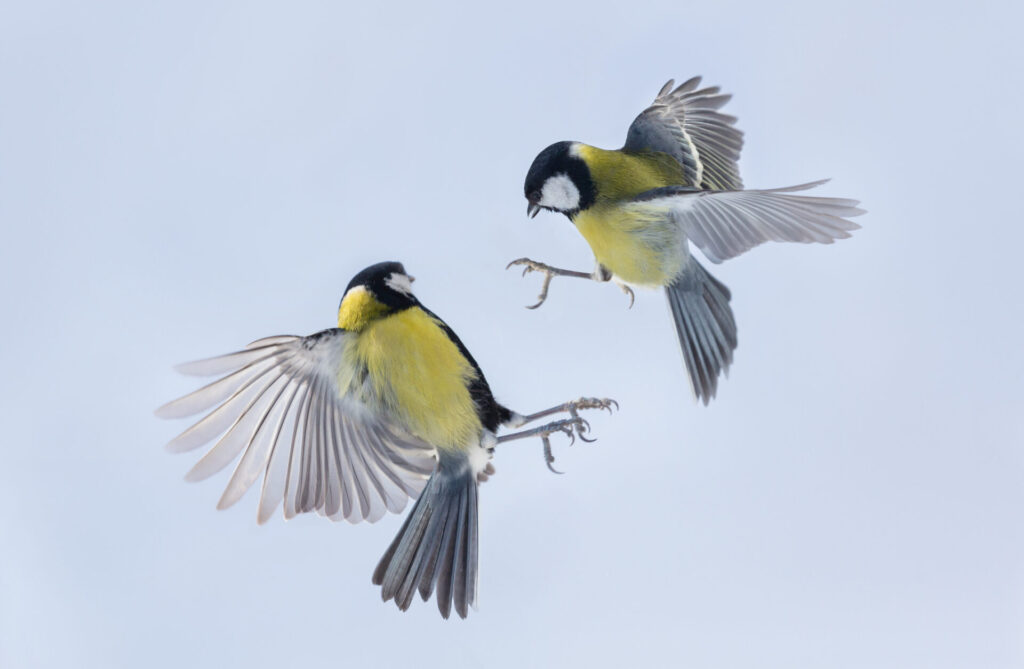
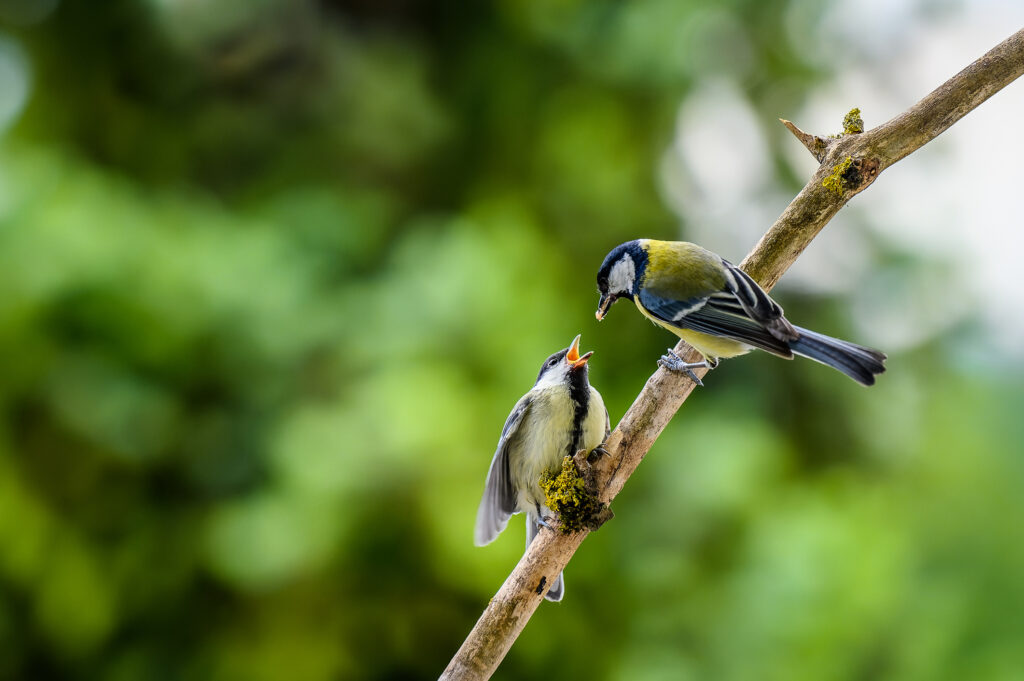
It turns out that European Great Tits can primarily feed on young oak processionary moth caterpillars before they turn hairy. Birds with chicks will eat significantly more, but smaller, caterpillars during that time. There are, in fact, quite a few species that do this. In spring, most birds require access to a high protein source of food to feed chicks. Even seed-eating species will switch diet to nurture fledglings.
Blaming climate change is not the point
According to CNN The Nature ConservationWhy is animal conservation important? Animal conservation is important, because animals are the only mechanism to create biodiversity, which is the mechanism that creates a habitable planet for humans. Without animals, the energy from today’s plants (algae, trees, flowers etc) will eventually reach the atmosphere and ocean, much of it as carbon. The quantity of this plant-based waste is so More Foundation of Berlin has ‘said that the caterpillars originated in southern Europe but have gradually been spreading northward. The oak processionary moth is particularly prominent in hot and dry weather. While the insect has long been present in Germany, its increasing prevalence is due to climate change …’
Labelling climate change as the cause is like calling the moths a ‘pest’. These words bely the ecosystem’s true behaviour and distract us from the real possibilities around restoring nature. As I often explain, there is a difference between the reductive theories of ecology and the way ecosystems truly operate at scale. Further, words like ‘pest’ and ‘climate change’ indicate desperate problems to tackle, rather than primers for understanding the opportunities nature gives us to restore.
On that note, European ecologists are reporting how birds are now breeding two weeks earlier. On first thoughts, we might consider this is due to earlier springs and a warming environment. That’s a top-down assumption we make about climate right there. Immediately – you might think – climate is to blame for the birds’ earlier breeding season and therefore, this might make the birds go extinct. But what if there is another explanation?
If the birds’ chick survival is entirely dependent on the moths, then it makes sense that their breeding season would align with the appearance of their caterpillars. The birds become a solution mechanism, not a problem to worry about. Complex animals are highly adaptable after all. On the whole, we underestimate this power and can only imagine the doom equation.
Our rather over-simplified assumptions lead to despair, which leads to reactive solutions like vacuum cleaners and pesticide. Whereas the nature-based solutions are staring us in the face. They lead to greater rewards as our local environments become more habitable for all.
The scale, intensity and magnitude of Europe’s most studied bird
Climate change is certainly causing caterpillars to move north but despite being an inconvenience for people, it has become an opportunity for birds like Great Tits. The question we need to be asking is whether we are giving the birds enough of their own ecosystem needs to capitalise on this for our benefit.
Great Tits, it turns out, are one of Europe’s most studied birds. In the UK, they are part of a more than 75 year long study in Wytham Wood, Oxfordshire. According to a summary in this lovely article, there are approximately 400 breeding pairs of Great Tits in Wytham Wood producing 2,000 chicks a year. Each clutch of 8–9 young will eat 70 caterpillars a day over a period of a couple of weeks. That is a quarter of a million caterpillars in two weeks! Great Tits, as I have already mentioned, are found in woodland all over Europe and Asia (scale). In the Netherlands, Great Tits were the most frequently spotted bird in a recent census with 273,142 sightings. By the way, if each of those represents a pair, that’s 280 million caterpillars eaten.
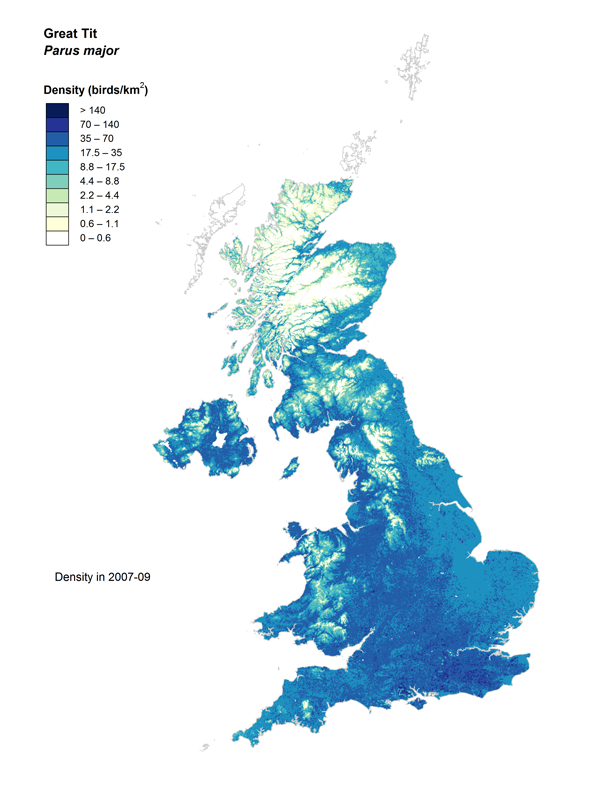
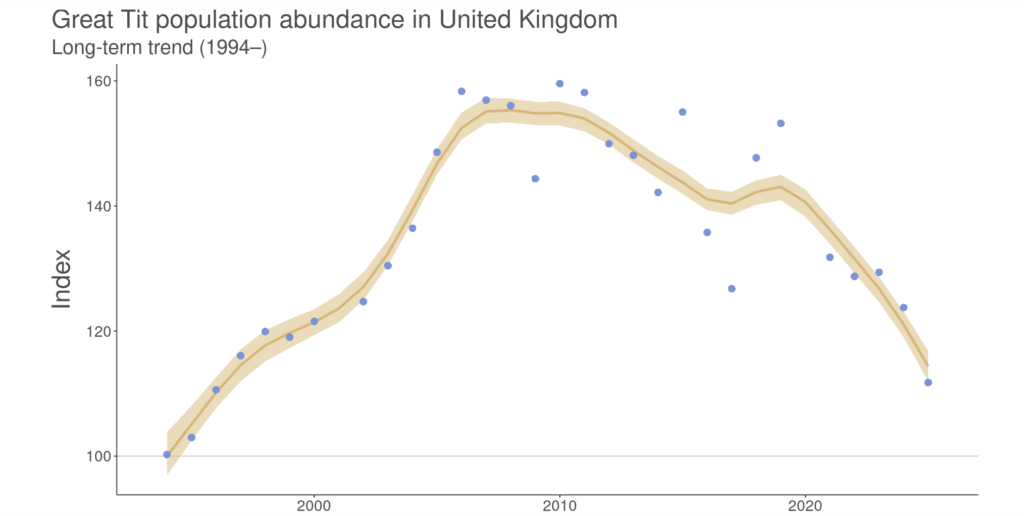
Great Tits consume massive amounts of caterpillars (intensity) and are prolific breeders. The magnitude is indicated by their density, which is significant, as the following figure from the British Trust for Ornithology shows. Yet, as the population data shows, their numbers have also been steadily in decline since about 2020. While Great Tits are generally increasing in number across Europe, there is a worrying decline around urban areas … the very places we need them. We’re not doing enough to nurture their needs, so the habitability of our own neighbourhoods is now being affected.
The proof is in the eating of oak processionary moths
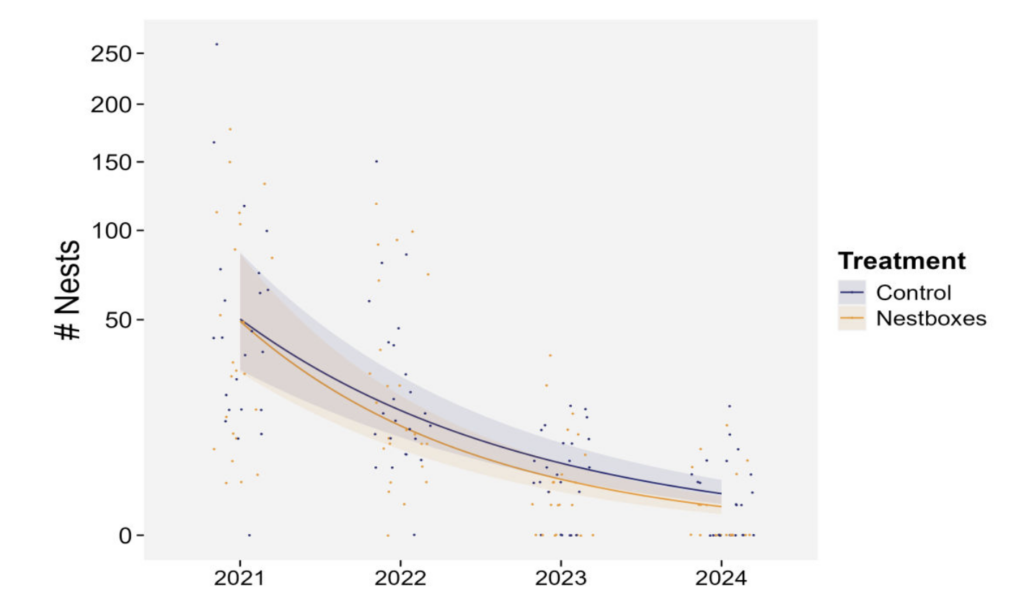
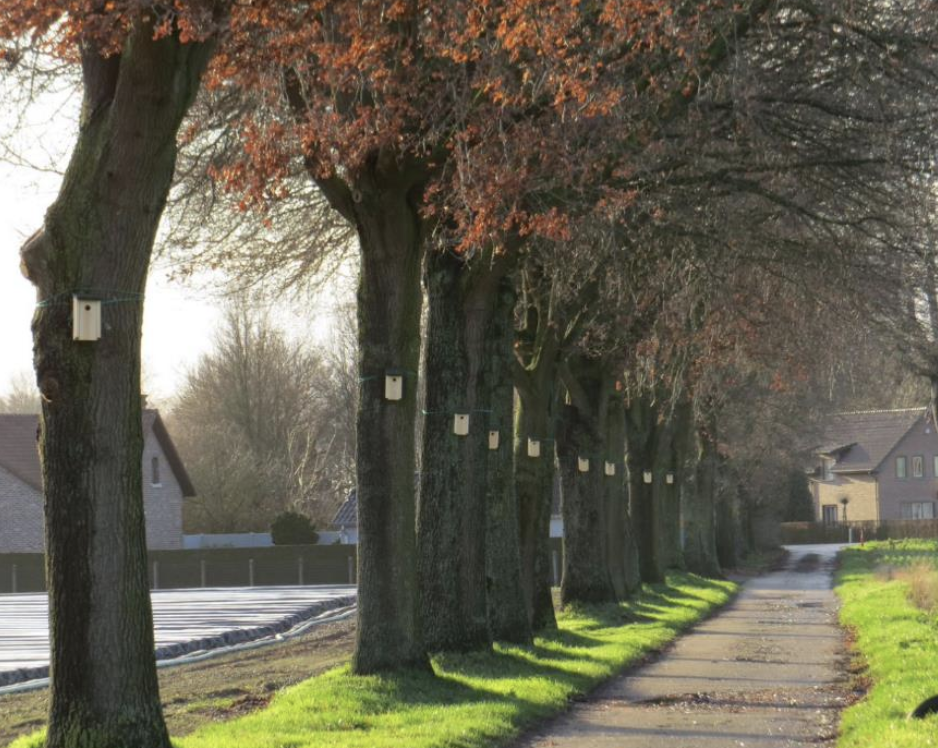
The proof is, as they say, in the eating. Unsurprisingly, I am not the first to think about this effect. The LIFE Oak Processionary study by De Bruyn et al. sought to experiment on the idea (see images, below).
Four years after installing nest boxes, oak processionary moth numbers were about 70% lower at the sites with nest boxes compared to those without. Proving that enhancing breeding sites for Great and Eurasian Blue Tits (a related species) greatly helps to reduce caterpillar populations at an infested site. Most of this effect was due to the faster decrease in caterpillar nest size.
What stops all of Europe from acting now to restore Great Tit populations?
Too much research and not enough empowerment for local doing
The aforementioned LIFE project begins with this statement:
“So, while more research is needed, it’s reasonable to think that tit predation could help manage oak processionary caterpillar numbers.”
Why is more research needed? When did we start to think this way? It pains me to say this but research scientists can be among the worst culprits of delaying nature-based solutions at a local level. There is too much experiment and research. Too much ownership of nature outcomes by institutions and not enough empowerment of everyday people to act in their own local interests.
The only certainty in life, is that ecosystem balance restores resilienceReferring to an ecosystem’s ability to maintain a steady stable-state. The need to build resilience is entirely anthropocentric and symptomatic of ecosystems that are damaged or declining, leading to loss of ecosystem services on which humans depend. More and productivityThe power of an ecosystem to process energy. The most productive ecosystems have reached a steady stable-state with maximum entropy production. That’s to say, the number of species has reached an optimum and the functions they fulfil, have translated free surplus energy into nutrients that is either stored inside plants and animals, or is entrained within the biological cycles that More. The first thing we should do is look to see what animals are missing and begin recreating the opportunity for them to survive. Then and only then can we see for ourselves what happens. By the way, this doesn’t necessarily mean ‘rewilding’. Introducing lost species is not the only answer. We have many that still exist.
Fear of the unknown consequence of nature encroachment
Our generation only knows wildlife decline. We’ve also grown up in the culture that believes neatness and orderliness is elegant and valuable. From an ecosystem energy perspective, this is the messiest of all. What looks messy from the outside is actually more orderly and sustainable, which means it supports our lives more greatly.
Most of us haven’t experienced nature in its full glory. We are scared to act and await years – even decades – of research before doing anything. There is a fear that nature will become more inconvenient. That we will compromise our current standard of living by allowing it to encroach. Yet here we are. Facing seemingly insurmountable environmental challenges while wanting to seek more time in nature as our lifestyles become more stressful and hectic.
In fact, for the most part, restoring nature means doing less to create more value. We can stop spending money holding nature back and acquire 7-30x more value. Often it just means small tweaks to our lifestyle, like allowing smaller shrubs to grow, or avoiding the use of pesticide. It makes us more productive, not less.
Despair and a belief we are individually powerless to do anything
Our lives are full of doom and gloom. We are made to believe we lack knowledge and are powerless but it’s a deliberate illusion meant to keep us in fear. Even the rhetoric of conservation organisations is the same and it creates anxiety. Climate change is disempowering and makes us beholden to institutions that are paid to ‘solve our problems’ through more research. Relatively little action is taken and it dilutes our own sense of purpose and community.
Yet in our fear space, we are more likely to make rash, reactive and unwise decisions. Despair and a general want for society to see something done, leads to desperate measures. The misuse of poisons and other methods that are expensive and contrary to nature. This has led to us spending more on maintaining our environment than we get back from it, which results in a rapidly growing cost of living. For all these reasons, dominant mindset of councillors, the public and many scientists, remains committed to control rather than nurture of communities and nature alike.
Nature-based opportunity and the opportunity for all our lives
The fact remains, that the area the aforementioned LIFE study was done, couldn’t exactly be considered ‘woodland’ in a functional sense. The image above, with nestboxes, illustrates this. Trees pollarded with long trunks and no understory provide little scope for natural processes to take place. Manicured parklands are dying habitat as there is no recruitment of new vegetation or the wildlife-driven processes that enable that to form a balance with human needs.
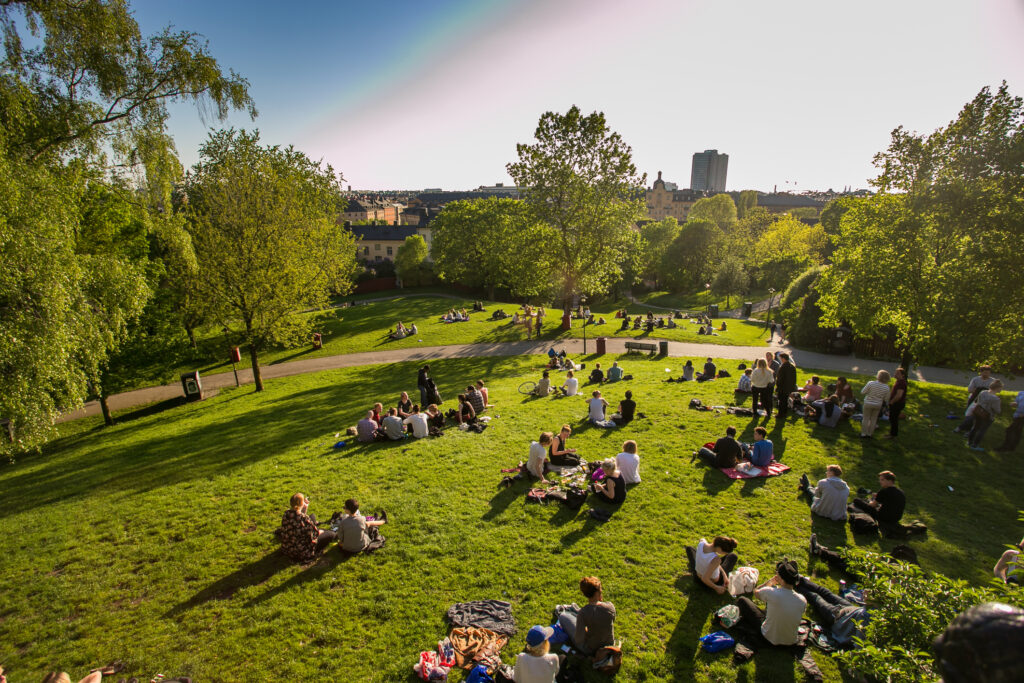
Consider, for a moment, the impact on people of those park closures during summer. For the last two years I’ve been canvassing people on the percentage of their own personal productivity linked to regularly visiting the outdoor places they love. At present, the results indicate 60% of our entire productivity might be due to these simple pleasures. The impact of losing free open space in cities can have drastic consequences for whole economies.
The whole reason we have birds and animals, is that they were the likeliest to survive in a changing world. Sure, the environment is changing faster at the moment. But that’s all the more reason to imagine animals’ ability to adapt and bring systems back into balance, should be revered. Especially in urban and semi-urban environments. Birds that can withstand human encroachment are more critical because they adapt fastest. They are humanity’s best hope.
What can I do about it?
Conservation starts at home and the more you take lessons from nature, the more you’ll be happier and able to be part of a solution. Here is my advice:
- Stop worrying about world problems and focus on your backyard.
- Stop watching the news and fostering fear. Choose what you read and take lessons from nature instead.
- Do what you can in your own place. It might just be your garden. You’ll see instant and satisfying results.
- Spread a message of inclusion, possibility and opportunity. Avoid conversations about doom.
- Vote for leaders who respect and understand nature.
- Help those who don’t understand to learn and feel better about themselves. Remember, we all share in this dilemma.