
The importance of the oceans, their wildlife and ecosystems
The land and oceans are part of one system: Earth. So when we ask, why are the oceans important? We’re asking about our own future. Life began in the ocean billions of years before the first plants or animals colonised land. Oceans regulate the state of our atmosphere because they are 99 per cent of the volume of living space for animals and wildlife is the mechanism that drives stability.
Climate change has always been the symptom of biodiversityWhat is the definition of biodiversity? When we ask, what is the definition of biodiversity? It depends on what we want to do with it. The term is widely and commonly misused, leading to significant misinterpretation of the importance of how animals function on Earth and why they matter a great deal, to human survival. Here I will try to More loss … that’s to say, the breakdown of the complex connectivity between lifeforms that allows Earth to flex in response to changing conditions. Ocean wildlife has, for the large part, acted as a buffer against the most catastrophic effects and since about fifty million years ago, has kept our climate quite stable.
Industrial fishing only happened recently in our planet’s history and this reduction in the abundance of wildlife represents our greatest challenge for survival.
Below you will find a range of articles designed to inspire an understanding of the magnitude of animal impact on our oceans.
The importance of whales and dolphins in our oceans
What’s more important, the ocean or the land?
The importance we bestow on the land is anthropocentric because we live there. It’s naturally important to us that we protect it. Nonetheless, if life in the ocean dies, we suffer irreversible changes to land-based ecosystems and climate.
In this article, we take a look at many of the ways that land and oceans are linked together.
The answer to the question, ‘why are the oceans important’, is that we live on the land but the oceans regulate Earth’s temperature. The oceans are equally vital to the land we live on.
Seabirds
The necklace of remote Cook Islands landforms is a renowned safe haven for yachties and a sanctuary for 100,000 seabirds birds. But the islets became …
Sharks and Rays
Under the heading “Boy, 7, is rushed to hospital in a serious condition after a suspected shark attack at a beach south of Melbourne”, the …
Latest posts about why the oceans are important
A study just came out with former NASA climate scientist James Hansen. Therein, he warns that a reduction in the amount of atmospheric pollution could lead to an acceleration in climate warming. When it comes to cloud albedo, pollution and seabirds both have a role to play. But the animals rarely rate a mention.
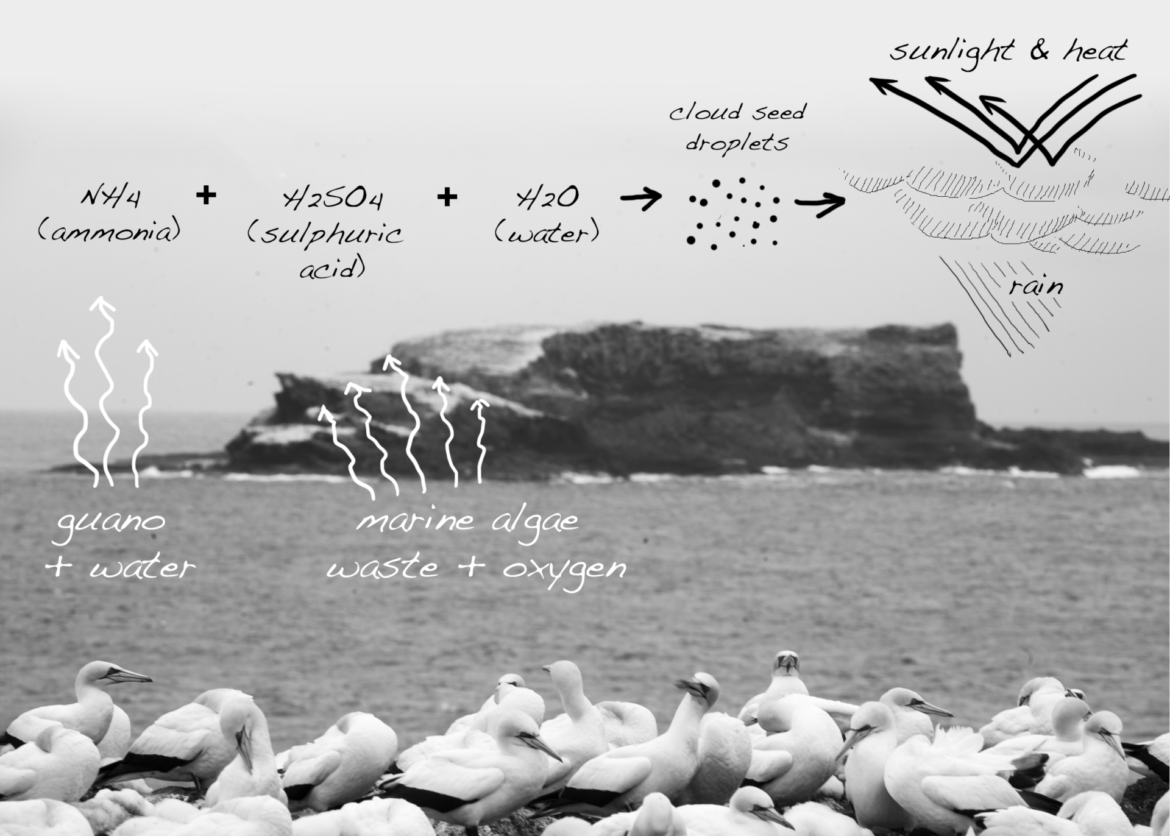
Hansen warns that scientists are dangerously underestimating the impact of aerosol pollution. The way this works is that pollutants create chemicals over the ocean. These form droplets that are the basis for cloud seeding. Brighter clouds reflect more of the Sun’s heat and that’s part of the reason Earth stays cool.
while shipping only accounts for about one-tenth of total global sulfur dioxide emissions, it represents nearly 100 percent of those emissions over oceans, which absorb more than 90 percent of all the heat trapped by greenhouse gases.
Inside Climate News
Seabirds increase cloud albedo by propagating clouds
But this is also a natural process. Seabirds are one conspicuous source of ammonia that has been shown to create rainfall on a continental scale [1, 2, 3]. Read more here.
The scale of natural seabird processes and cloud albedo
The aforementioned article skips over this component. It says aerosols come from ‘from natural and human sources, including smoke, pollen, fine minerals, volcanoes and even plankton-laced sea spray’. Why downplay the role of the natural plankton processes? These are, after all, the ones most in keeping with our habitation of global ecosystems. They are the ones driven by seabirds.
All scientists struggle to conceive the scale and intensity of animal impact. It’s difficult to measure. A recent study in Greenland [4] did look at seabirds and concluded, for the island’s east coast at least, that the effect was minimal. However, the geographic range of these impacts can be across whole continents and oceans. These effects are planetary, not isolated.
We need to be very careful. I believe what Hansen is telling us. Nature has shown us how sensitive our climate is to these types of chemical reactions. What he’s really saying, however, is that our pollution has shielded us against a worse problem. That underneath the blanket of pollution, there are clearer, warmer skies.
The reason for this?
Perhaps, it’s because we have killed all the seabirds. Is that too much to believe? After all, they were the major components of this process before industrialisation. Why is this fact not being discussed by conservationists worldwide?
- The truth behind edge effects in ecology and life
- Are Great Tits the Solution to Europe’s Hairy Caterpillar Plague?
- How your mind connects to nature and the universe
- How do I choose the best underwater camera for me?
- Underwater in the remarkable Lembeh Strait
The danger of declining seabirds and declining pollution
What of the seabirds and other marine animals? They have declined by over 70% in the last 50 or so years. We have killed the animals that form natural processes to shield us once we clean up our air pollution.
But anyone who goes out to study these effects today only measures a small proportion of what came before. And then, researchers tend to document linear effects. Birds produce a certain amount of guano but what of the transfer, amplification and concentration of nutrients? These ecosystem-level processes are poorly understood.
Others will jump to geoengineering solutions but these will be catastrophic. They replace complex ecosystem processes using a sledgehammer approach and still, the underlying seabird-driven effects are ignored. As described in Kolbert’s book Under a White Sky, we might create the illusion of fixing climate, and enable more carbon consumption. It only takes a global economic downturn to remove the manmade shield and descend once more, into climate chaos.
Isn’t this what Hansen is explaining to us right now? That by cleaning up pollution (which inadvertently protected us), we are unleashing the monster? When will we start to learn that the solution means rapidly restoring wildlife populations?
We have to start protecting and rebuilding seabird populations
When it comes to cloud albedo, pollution and seabirds fulfil the same role. But the latter do it in a more measured way that connects with our survival.
How are we going to rebuild the natural life support systems that came before all this? Unless we prioritise radical conservation outcomes, other efforts we make, will fail. This is a brilliant example of where wildlife is essential for human survival. Yet, it’s rarely talked about.
Let’s change the conversation, and explain why we cannot survive on Earth without rebuilding wildlife populations.
References
- Blackall, T., et al., Ammonia emissions from seabird colonies. Geophysical Research Letters – GEOPHYS RES LETT, 2007. 341.
- Riddick, S., et al., Measurement of ammonia emissions from tropical seabird colonies. Atmospheric Environment, 2014. 89: p. 35–42.
- Otero, X., et al., Seabird colonies as important global drivers in the nitrogen and phosphorus cycles. Nature Communications, 2018. 9.
- Dall´osto, Manuel & Geels, C. & Beddows, D. & Boertmann, David & Lange, Robert & Nøjgaard, J. & Harrison, Roy & Simo, R. & Skov, H. & Massling, A.. (2018). Regions of open water and melting sea ice drive new particle formation in North East Greenland. Scientific Reports. 8. 10.1038/s41598-018-24426-8.